
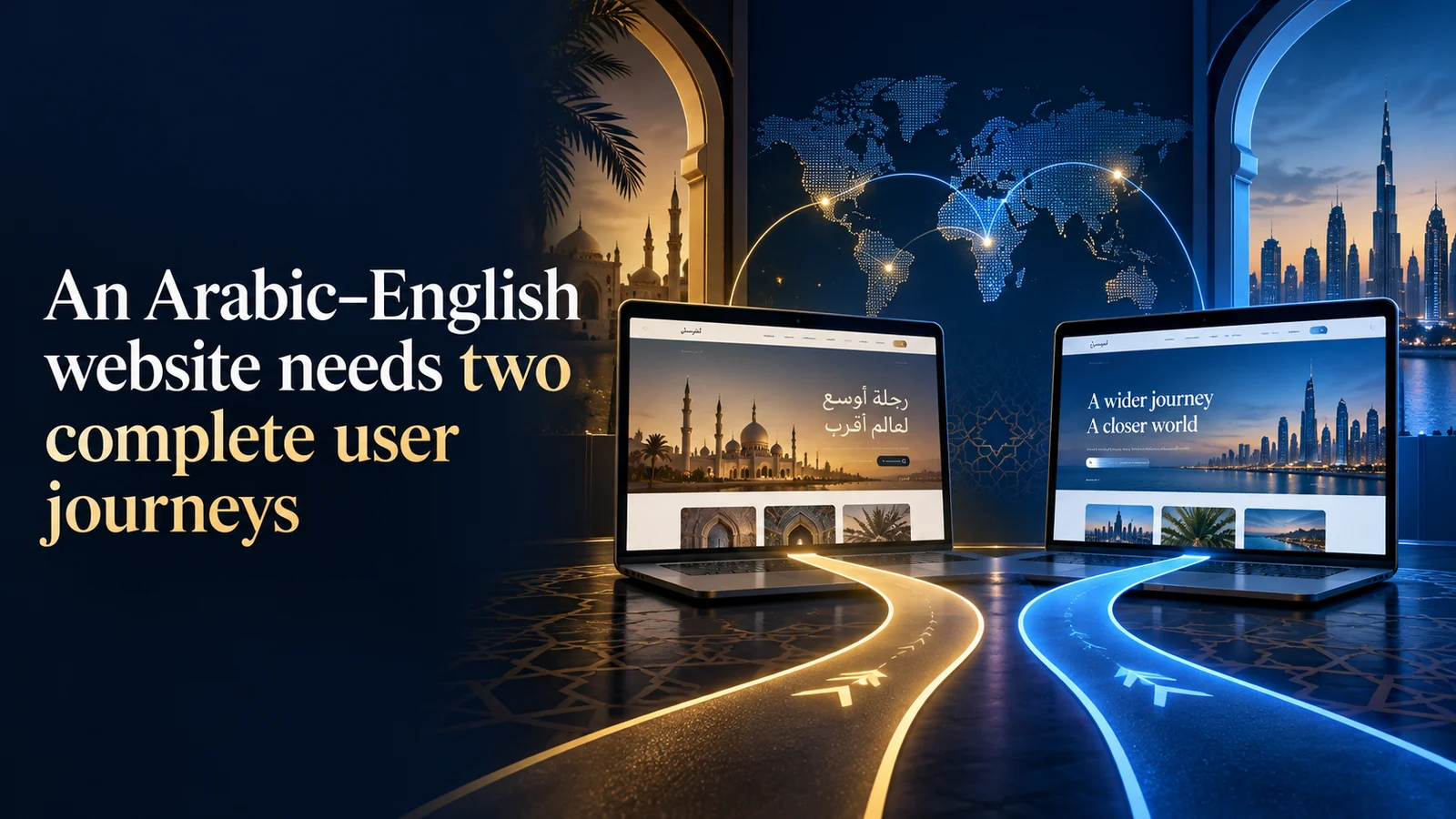
An Arabic–English website needs two complete user journeys
A bilingual site is not an Arabic interface produced by flipping elements, nor an English page translated word for word. Audiences use different phrases, examples, and trust signals. Each service page needs a title and explanation matching intent in its own language. Give each version a stable URL and connect equivalent pages in the language switcher. A visitor switching language on a service page should reach that service, not the other homepage. Google explains hreflang annotations for localised versions. They complement good content; they cannot repair a poor translation. Check that each language’s canonical points to the correct page. Test navigation, arrows, fields, numerals, tables, and overlays separately in RTL and LTR. Not every icon or data string should be mirrored. Arabic text can change card and button heights on mobile. Prioritise high-value home, service, and contact journeys, then localise relevant articles editorially.
A bilingual site is not an Arabic interface produced by flipping elements, nor an English page translated word for word. Audiences use different phrases, examples, and trust signals. Each service page needs a title and explanation matching intent in its own language. Give each version a stable URL and connect equivalent pages in the language switcher. A visitor switching language on a service page should reach that service, not the other homepage. Google explains hreflang annotations for localised versions. They complement good content; they cannot repair a poor translation. Check that each language’s canonical points to the correct page. Test navigation, arrows, fields, numerals, tables, and overlays separately in RTL and LTR. Not every icon or data string should be mirrored. Arabic text can change card and button heights on mobile. Prioritise high-value home, service, and contact journeys, then localise relevant articles editorially.
Related Unicode service: Web development services.
Map paired pages before translating
List each Arabic page and its English counterpart. A service page may have an equivalent meaning, while a local article about a Saudi requirement may not need a matching page aimed at another market. Do not publish a superficial translation just to fill a map. When versions are equivalent, link them in the switcher and technical signals. When one has no equivalent, choose understandable behaviour instead of dropping the visitor onto an unrelated page. Record who owns each translation and when it was reviewed so one language does not evolve while the other remains stale.
Prioritise pages receiving traffic or qualified enquiries today. Improve them before translating dozens of low-value posts. A page map keeps the language switcher contextual instead of turning it into a list of destinations unrelated to the visitor’s task.
URLs, hreflang, and canonical
Google’s documentation explains ways to signal localised versions. Choose a method your CMS can manage and verify that equivalent pages reference one another and themselves as required by the chosen implementation. `hreflang` and `canonical` are not interchangeable: the latter identifies a preferred version among similar pages and should not accidentally remove Arabic in favour of English. Inspect rendered output, not just plugin settings.
Avoid automatic location redirects as the only route. A Saudi visitor may live abroad or prefer English; search engines and customers need direct access to a chosen URL. Offer a clear choice, remember preferences without trapping people, and map old URLs to relevant new pages when structure changes. Check menus and sitemaps after every migration.
Search language differs from translation language
Do not begin with an English keyword and translate it literally. Research what buyers type when seeking the service in each language and what questions precede contact. An Arabic CRM development page may need more precise terminology than a broad English label, or vice versa. Give each page one clear intent, useful headings and explanations, and links to an appropriate service or quote route. An Arabic article should not end at an English-only form its reader cannot use.
Localise meaning and examples, not country names and numbers without verification. If you mention local requirements, payment methods, or laws, check an authoritative source for the relevant market or remove the example from a version where it does not belong. Good bilingual content requires editing and periodic review.
Direction is more than a `dir` attribute
Set page and text direction, then test components mixing Arabic and Latin content: phone numbers, email addresses, order codes, tables, and search inputs. Step arrows or icon/text order can reverse incorrectly if everything is mirrored automatically. Reverse genuinely directional controls while preserving brand marks and universal symbols when mirroring changes their meaning. Check validation messages, dropdowns, and date pickers in forms.
Test a small phone and larger text settings. An Arabic heading may wrap and break a button sized for English. Flexible cards should accommodate extra lines without creating huge blank spaces in shorter versions. Readability, contrast, and target size matter in both directions.
Forms and messages are part of the journey
A translated contact page is incomplete if its success message or internal response email uses the wrong language. Submit a form from each version and inspect field validation, confirmation, automated email, and whether CRM records enquiry language. If a buyer switches language mid-journey, avoid discarding entered data. Keep switch URLs clean rather than adding unnecessary parameters that create duplicate pages.
Decide who answers enquiries in each language and how quickly. Publishing English without a team capable of discussing a project in it can create unsupported leads. Review internal linking: English readers should usually find English services and resources, and Arabic readers Arabic ones, while retaining an intentional switch.
Test before and after release
Sample homepage, services, posts, and contact pages in each language. Review H1, descriptive metadata, links, image text alternatives, reciprocal annotations, and canonical output, then inspect mobile layout. Open pages as a signed-out visitor, switch language from the middle of a journey rather than only the homepage, and send a test enquiry. After publication, watch broken links, indexed pages, and enquiries by language and repair what real use reveals.
A successful Arabic–English website is a connected content, experience, and SEO system, not a translation layer or mirrored stylesheet.
Bilingual site plan
Share your page map and audience by language to prioritise content, links, and RTL/LTR testing. Contact the team.
—