
 العربية
Understand what really affects app development pricing, from product scope and platform choice to integrations, testing and long-term support.
Mobile app development cost in Egypt and Saudi Arabia depends far more on scope than on a single market average. A booking prototype, a two-sided marketplace and a regulated customer portal may all be called “an app”, yet they need very different design, infrastructure, testing and support. A trustworthy budget starts with requirements and assumptions, not a universal price tag.
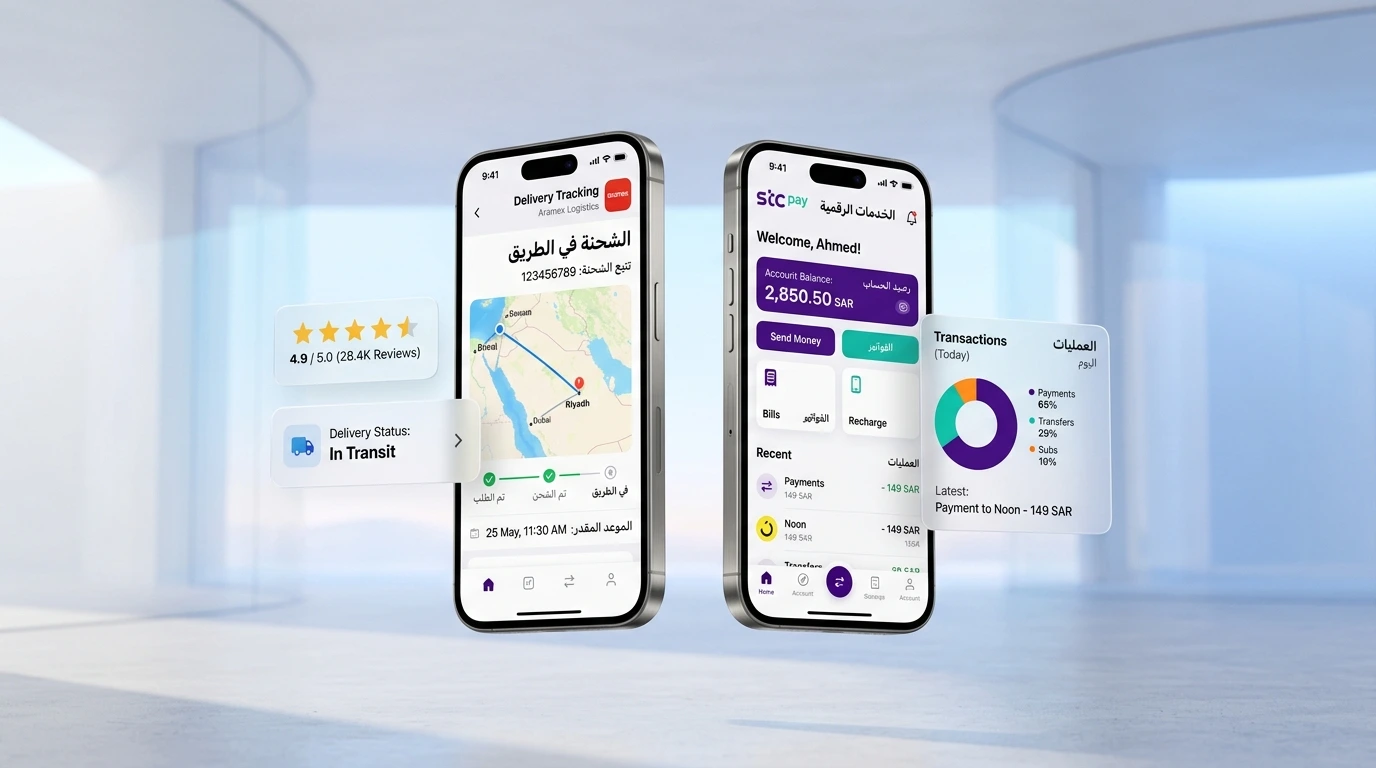
This guide explains the cost drivers that matter most, the differences to discuss with teams in Egypt and Saudi Arabia, and how to request proposals that you can actually compare. Any quote should be validated against a written feature list and the responsibilities of both parties.
Write down the user roles, main tasks and minimum acceptable outcome. A single-role content app may need login, a simple dashboard and notifications. A marketplace may also need seller onboarding, catalogues, payments, disputes, payouts and an admin console. Those workflows determine effort more reliably than the number of screens.
Separate “must launch” from “could launch later”. For a first release, prioritise the journey that proves your idea: a customer completes a booking, places an order, or submits a qualified request.
Analytics, support processes and admin operations are part of that journey. A visually complete interface without a workable back office is not a complete product.
Define who uses the app and what permissions, actions and information each role needs.
Identify the customer action that proves the first release can deliver real value.
Include administration, analytics and operational workflows rather than designing only the customer screens.
Mobile app development cost should be reviewed at every milestone. If discovery reveals new roles or integrations, revise the estimate and document the trade-off before work expands.
Compare the cost of a usable first release with the cost of delaying an essential operational feature.
These components should appear as separate lines in a proposal. If one quote is dramatically lower, check whether it excludes design, source-code ownership, store submission or maintenance.
Location can influence rates, availability and working practices, but it does not replace vendor due diligence. A team based in Egypt may deliver for a Saudi company; a Saudi-facing app may need localised content, support processes and integrations regardless of where development happens.
Confirm who owns discovery, communication, hosting and final approval.
Evaluate the team's technical capability, communication, documentation and ongoing support rather than location alone.
Consider Arabic localisation, market-specific integrations, payment workflows and operational requirements.
Clarify responsibility for infrastructure, compliance, accounts, data and final approvals.
For a Saudi launch, validate any industry-specific, privacy, invoicing or payment requirements with qualified local advisers and the chosen providers.
For an Egyptian launch, do the same with applicable local requirements. Requirements can change, so do not rely on a generic article as legal or financial advice.
Native development can be appropriate when deep platform features, specialised performance or complex device behaviour are central to the product.
Cross-platform approaches may reduce duplicated interface work for apps with broadly similar experiences on iOS and Android. Neither is automatically the cheaper long-term choice: plugin limitations, integration complexity and team expertise affect maintenance.
Ask vendors to justify the selected architecture with your product’s needs.
The official Apple Developer Program and Google Play Console pages explain platform account and publishing processes.
UNICODE can help define the first release, prioritise the right features and explain the technical trade-offs before development begins.
A fixed price can be useful after scope and assumptions are sufficiently clear. Before then, a range or discovery phase is usually more honest.
No. It can reduce duplicated work, but complex integrations and long-term maintenance may change the calculation.
Define incident response, security and dependency updates, store releases, analytics monitoring and a process for new features.