
 العربية
Choose the right first investment based on customer discovery, repeat orders and what your team can maintain.
Mobile app vs website for UAE ecommerce is not a contest with one universal winner. The right first investment depends on how customers discover you, how often they buy, and what your team can maintain. A responsive website is usually the easier discovery and validation channel. An app becomes compelling when customers have a reason to return frequently and value features that justify installing it.
Related Unicode service: Ecommerce website development.
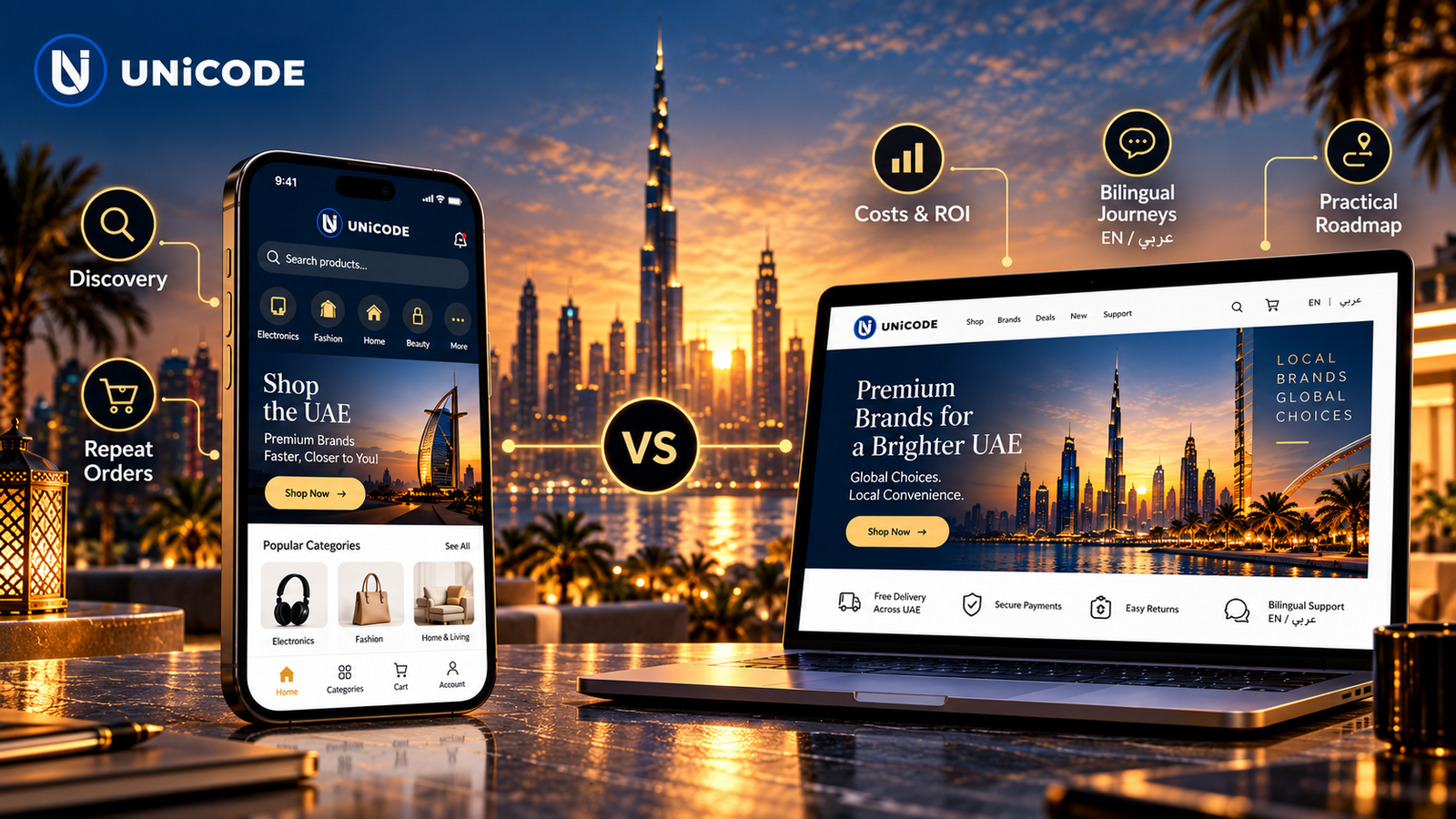
This guide turns the choice into a business decision. It covers customer acquisition, repeat orders, operating costs, Arabic and English experiences, and a realistic path from one channel to both.
Map the buying journey before asking a developer for a quote. Where do new customers first see the offer: Google Search, social media, a marketplace, a QR code, or an existing customer referral? How often does the same person reorder? Which part of checkout is slow? A channel should remove a measured friction point rather than exist because a competitor has one.
For a new business with little first-party traffic, a mobile-friendly site provides a shareable destination for campaigns and search results. A returning-customer business may have a stronger app case if saved preferences, loyalty, repeat ordering, or personalised notifications provide a clear benefit. Check your analytics and interview customers before committing to either route.
A responsive ecommerce website works across devices without an installation step. It can host product and category pages, support paid landing pages, and give search engines crawlable web content. It is also easier to share a specific product through a message or social post. Those advantages matter when acquisition and testing demand are the main goals.
The mobile app vs website decision should be revisited as customer behaviour changes. If repeat orders rise and customers ask for faster reordering, an app pilot has a stronger business case. If new-customer acquisition remains the bottleneck, prioritise the mobile website and its product content.
The site still needs serious execution: fast product pages, readable mobile typography, a transparent delivery policy, secure checkout and a straightforward path to support. A poorly designed site is not automatically cheaper than a good app; scope, integrations, content preparation and ongoing improvements drive the actual cost.
Google can also connect web pages with app experiences through app deep links. That is why “an app never appears in search” is too simplistic. The web remains the most direct way to publish indexable product information, while an app can serve an installed audience.
An app makes more sense when a meaningful group of customers already comes back. Repeat grocery orders, recurring bookings, stored addresses, loyalty rewards and time-sensitive updates are examples of needs that can benefit from an app. The question is whether these features improve a specific retention or conversion metric enough to cover development, store review, support and updates.
Do not use push notifications as a substitute for value. People may disable them or uninstall an app that asks for too much attention. Design permissions carefully, explain the benefit, and provide an equivalent way to complete important tasks on the web where practical. Store approval is another part of the launch plan: review the Apple App Review guidance before finalising scope.
For many UAE merchants, Arabic and English are core journeys rather than a last-minute translation task. Test product names, search terms, form labels, checkout, help content and right-to-left layout with real users. Decide whether prices, delivery zones, returns and support hours differ by emirate or customer segment.
Choose payment and delivery providers based on your actual business model and current contractual requirements. A gateway that supports your preferred checkout does not by itself solve settlement, refunds or logistics. Ask vendors to demonstrate failure states, refunds and customer-support workflows, not only a polished happy path.
Scope a shared backend and a staged launch for your ecommerce experience.
Not always, but an app adds platform testing, store processes and ongoing release work. Compare detailed scopes and total ownership costs, not headline prices.
Yes. Plan product, customer and order data so a later app can reuse reliable APIs and permissions.
A mobile website is usually easier to share and discover. An app needs a clear reason for a new customer to install it.