

Contractor Website Checklist: What Wins Serious Project Enquiries
Contractor website design should help buyers assess your capabilities, inspect relevant work and send useful quotation requests. Attractive photographs do not establish what you delivered. This guide helps construction and fit-out businesses serving Saudi Arabia plan a usable sales journey, with requirements adaptable to genuine operations in the UAE or Egypt. Looking for a team to build it? See our construction company website design service.
Define your contractor website design audience
Choose the buyer you need to serve: a homeowner planning a renovation, an operations manager fitting out an office, or a procurement team comparing project partners. Each needs different information. Homeowners may need a straightforward process explanation; procurement teams may need a company profile, relevant project scope and an appropriate commercial contact.
Related Unicode service: Web development services.
Document services you perform directly, work delivered through partners and the locations you actually cover. Clarify projects outside your scope. This improves enquiry relevance without pretending to serve every possible requirement. Do not create city pages that imply offices or delivery teams you do not have. Describe operational coverage accurately rather than stretching geographical claims for search visibility.
Give your project portfolio useful context
For every published project, state its type, your contribution and its status. Use photographs with permission. If your company delivered the interiors, do not imply that it built the whole property. Confidential client names can be omitted while preserving an honest scope description. Generated architecture can illustrate a concept, but it is not evidence of completed work.
Group projects by the service buyers are assessing. Someone planning a restaurant fit-out benefits more from comparable work than unrelated facade photographs. Add verified constraints or delivery stages where appropriate. Review Unicode’s portfolio to assess presentation quality, while avoiding assumptions that unrelated projects establish experience in a particular construction specialty.
Make service pages explain the boundaries
Construction, refurbishment and maintenance require different explanations. Describe what each service includes, the inputs needed for an estimate and how a buyer starts the process. Avoid fixed completion promises without knowing specifications, site conditions and required approvals. A short preparation checklist is more useful than interchangeable statements about quality.
For a bilingual contractor website design project, have your team check technical terminology and keep project facts consistent across languages. Link service pages to relevant projects and a contextual enquiry form. Preserve the service that led to the request instead of dropping every visitor onto a generic contact page with no useful context for the sales team.
Build a quotation form people can complete
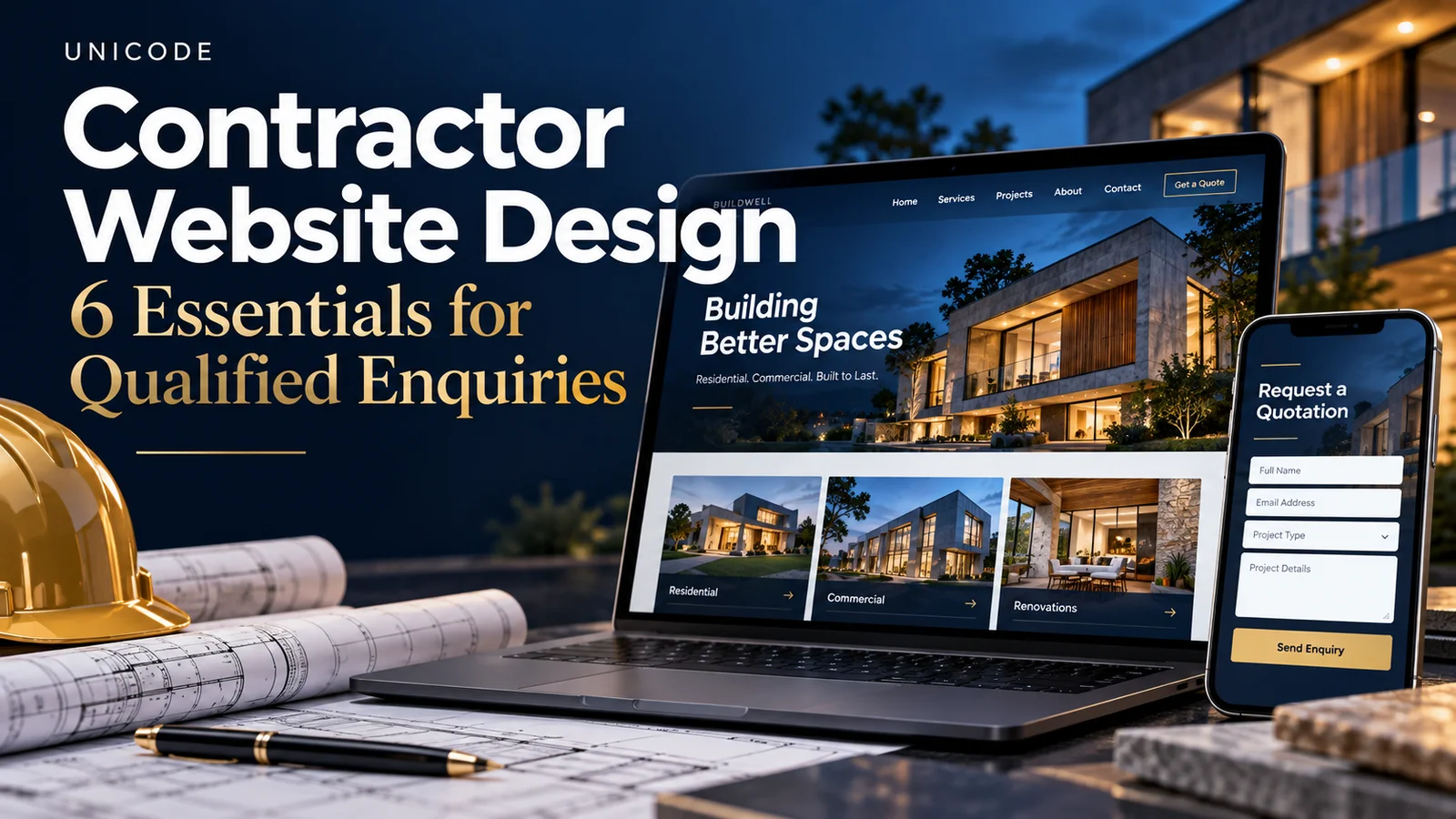
Start with project type, location, a concise description, current planning stage and contact details. A preferred start date or budget band can help qualification when the team genuinely uses it. Explain that an estimate requires review. Do not demand a long technical questionnaire before visitors can tell whether your company handles their kind of project.
If drawings are necessary, agree permitted file types, size limits, access rules and your approved retention process. Client documents should not become public download links. The confirmation message should acknowledge receipt, not approve a quotation or construction date. The W3C guidance on form labels is a useful reference for making fields understandable.
Assign enquiries to an actual workflow
A WhatsApp button does not establish a sales process. Identify who receives requests, who collects missing information and who prepares quotations. Record the requested service and referral context so buyers do not have to repeat their explanation. Use practical statuses such as new, qualified, site visit required, proposal sent and closed.
Measure useful enquiries separately from button clicks, and contracts separately from enquiries. Review which services attract projects that fit your company rather than counting every message as a lead. If a sales system already works, consider connecting it instead of replacing it. A construction company website and internal project accounting are different development scopes.
Agree the handover before comparing prices
Ask proposals to separate content preparation, design, portfolio management, forms, languages and integrations. Name the person providing project photographs and the person approving descriptions. Demonstrate how staff will add another completed project without developer intervention. Portfolio updates are routine work, so maintenance should be part of the original design decision.
Test a complete mobile enquiry, email delivery, file access and the language switch. Confirm domain ownership, administrator access, backups and update responsibilities. Agree who handles a failed enquiry notification after launch. These operational details make proposals comparable and prevent a lower headline price from hiding an important exclusion.
A first-release planning example
Imagine a fictional office fit-out company with six projects it may publish. A useful first release could include three service pages, a filtered portfolio and a form collecting project type, location and preferred start period. This is an illustrative scope, not a Unicode customer case or a promised commercial result.
- Open a project from its relevant service page.
- Check errors when a necessary field is missing.
- Submit outside working hours and verify notification delivery.
- Add a project using a restricted staff account.
- Review photographs and files on a slower mobile connection.
Questions before commissioning the website
Do we need a tender portal? Not automatically. General enquiries are different from controlled document exchange and formal tender submissions. Document that process before adding a separate portal.
Can a ready-made theme work? It may, if it supports the required content structure, forms and maintenance workflow. Evaluate fit and usability rather than choosing solely between “template” and “custom”.
Should we publish every project photograph? Select relevant, authorised images and optimise their sizes. A gallery should support a buyer’s decision without delaying access to the service information or enquiry form.
Takeaway and reference
Effective contractor website design combines a clear specialty, credible project context and a quotation journey the team can support. The W3C labels reference helps assess forms; acceptance tests must still reflect your business workflow.
Discuss your construction website scope
Send Unicode your specialties, genuine service coverage, publishable project examples, required languages and current quotation process. These inputs support a focused implementation discussion rather than a generic website package. Discuss your requirements on WhatsApp.