

Car Rental App Development: Booking, Fleet and Contracts Explained
Car rental app development starts with reliable availability for the requested branch and period, not an attractive search screen. Reservations must connect to payments and handover while handling maintenance, delays and cancellations. This guide helps rental businesses serving Saudi Arabia and their genuine markets define implementation requirements. It does not determine renter eligibility or create contractual terms on the company’s behalf.
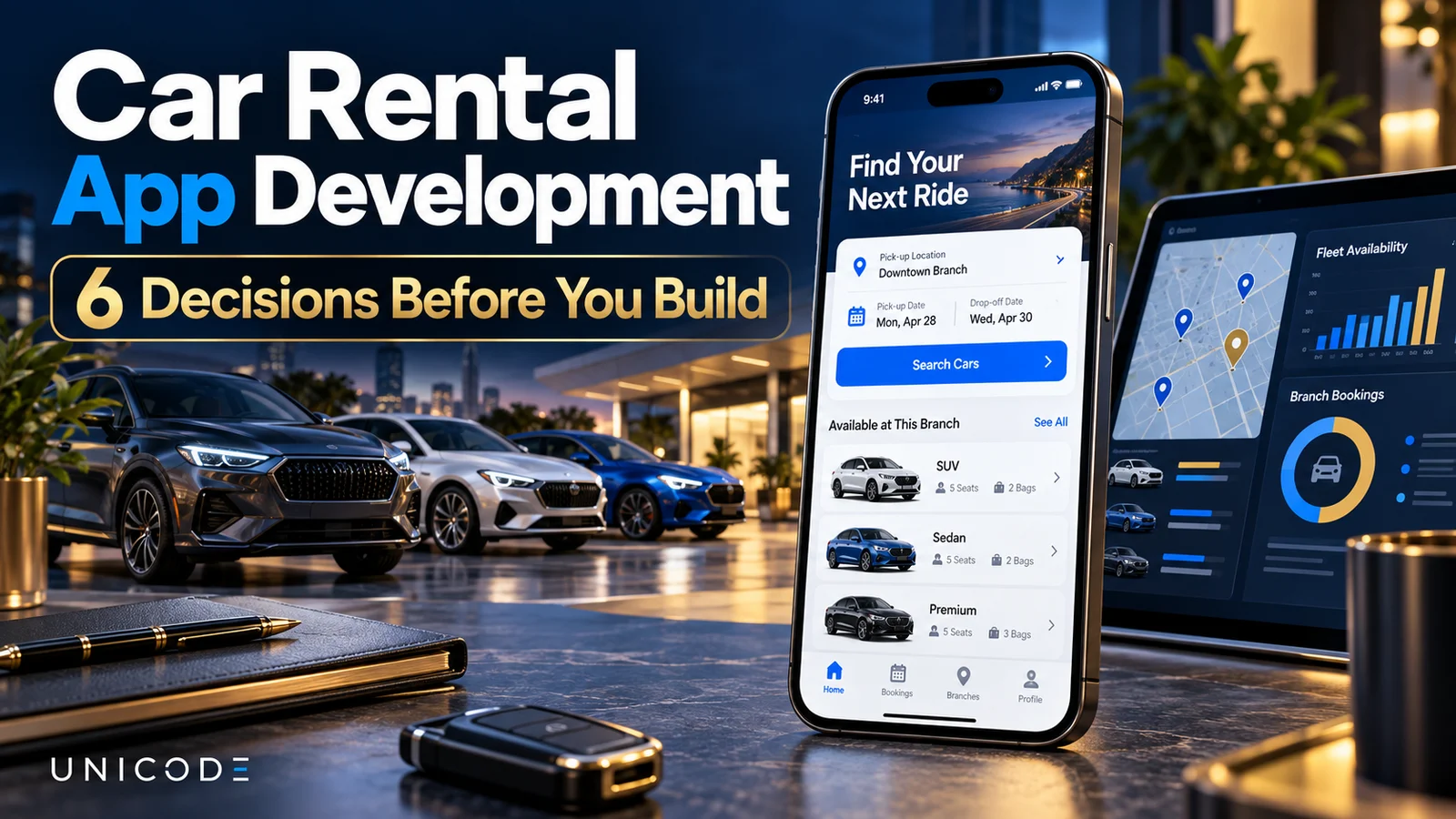
Define your car rental app development objective
Does the app present vehicle categories for staff review or reserve live inventory immediately? Do customers select a particular vehicle or a category allocated later? Photographs can imply a specific model even when the operation supplies an equivalent category. The interface and acknowledgement must reflect the approved operating rule.
Describe the app’s relationship to the website, branches and current management system. A mobile website may be a practical starting point for occasional bookings, while recurring account tasks can justify an app. Do not combine customer software, fleet management and accounting into one vague scope before deciding which systems need development and which need integration.
Use one dependable availability source
Identify who maintains the fleet record and how it marks a vehicle as reserved, under maintenance or not yet returned. Availability across dates requires more than a branch vehicle count. Define pickup and return times, operational turnaround intervals and the effects of delayed returns or changed branches.
If a management system exists, inspect its interface and update process before promising synchronisation. Test near-simultaneous requests for the last available category. Updating the customer interface alone does not establish conflict prevention. Staff confirmation can be an intentional first-release step when reliable live reservation data is unavailable; pending requests must not be presented as confirmed bookings.
Explain pricing and approved additional charges
Build quotations around the company’s approved rules: rental period, category, branch, extras and any other authorised elements. Explain what the total includes and what requires review. Do not invent deposit amounts or insurance conditions. Financial and contractual wording belongs to the business and its qualified advisers, not a developer’s assumptions.
Test extensions, changed times and additional services so the quotation updates consistently. If a price changes before confirmation, show the change through the approved acceptance process. A compelling rate on a vehicle card is insufficient when the actual total or conditions appear only after a request has already been submitted.
Keep booking and verification proportionate
Define information needed for an initial request, followed by any approved eligibility and document-review stage. Sensitive uploads should not automatically be the first step in browsing. Document who can access files, how retention is handled under the approved policy and which details marketing or general support employees do not need.
Explain device permissions as well. Branch selection may work manually without continuous location access. Android’s permission guidance recommends minimising permission requests and supporting alternatives when access is refused. Declining location should not prevent a customer selecting a city or branch where ongoing tracking is unnecessary.
Connect payment, reservation and handover states
Agree practical statuses such as new, under review, confirmed and ready for collection. Define their meaning and who may change them. Payment and reservation are not interchangeable. Exceptions need an understandable workflow rather than a single success message applied to every outcome.
Ask the implementation partner to test retries without creating duplicate requests or charges. Stripe’s idempotent-request reference illustrates the technical principle, not a ready-made integration for every provider. Use your actual provider’s test environment and verify that notifications retain the correct reservation reference.
Build an operating dashboard the team can manage
Employees need branch, time, status and ownership information, not just a customer list. Map permissions for branch staff, support and fleet management. Identify who handles an unavailable reservation and communicates with the customer. Keep a useful change history so exceptions can be understood without reconstructing scattered conversations.
When requesting mobile app development, provide existing systems, available interfaces, staff roles and booking scenarios. Separate implementation, integration, hosting, publication and support. Test Arabic, English, error messages and returning sessions. Maintenance should cover operational reliability rather than merely adding new vehicle photographs.
Car rental app development: example and acceptance checks
Imagine a fictional two-branch business with limited categories and staff-approved reservations. The app searches by branch and period, records a clear request and routes it to a review dashboard. Customers receive confirmation only after approval. Without a dependable availability source, the first release should not promise instant reservation. This is an illustrative scope, not a Unicode customer result.
- Try an invalid rental period and inspect the explanation.
- Select a category unavailable at the chosen branch.
- Test competing requests against the same inventory.
- Repeat a test payment without creating a duplicate request.
- Change status using the correct branch account.
- Refuse location access and select a branch manually.
Test a delayed return too: identify affected availability, the responsible employee and the customer message. This exposes dependencies missed by a demonstration using only available cars.
Questions before commissioning an app
Should the app track vehicles? Tracking is a separate scope requiring an approved purpose, qualified legal and privacy review, and a specific integration. It should not be an automatic feature of every rental project.
Is there one standard app price? Availability sources, integrations, verification, roles and pricing rules change the scope. Compare proposals covering the same scenarios instead of headline figures alone.
Can we start with a few branches? Yes, where operating rules are clear. Test adding a branch, category and responsible employee so routine expansion does not require rebuilding the system.
Takeaway and technical references
Useful car rental app development connects dependable availability with understandable requests and manageable operations. Review permission minimisation and retry handling as technical references, while qualified advisers approve eligibility and contractual rules.
Discuss your rental app scope
Send Unicode your branches, allocation model, availability source, management and payment systems, and reservation approval stages. Those inputs support practical development discussions and acceptance tests matching your operation. Discuss your app on WhatsApp.